Internal links & orphan pages
Review discovered incoming links and pages with few or no observed connections. Potential orphan pages need a wider coverage check: an incomplete crawl cannot establish that a page has no links anywhere on the site.
See where your website repeats itself, where pages need attention and which findings deserve a closer look. Start with evidence, then decide what to improve.
Scan an authorised website. Review the coverage. Make informed changes.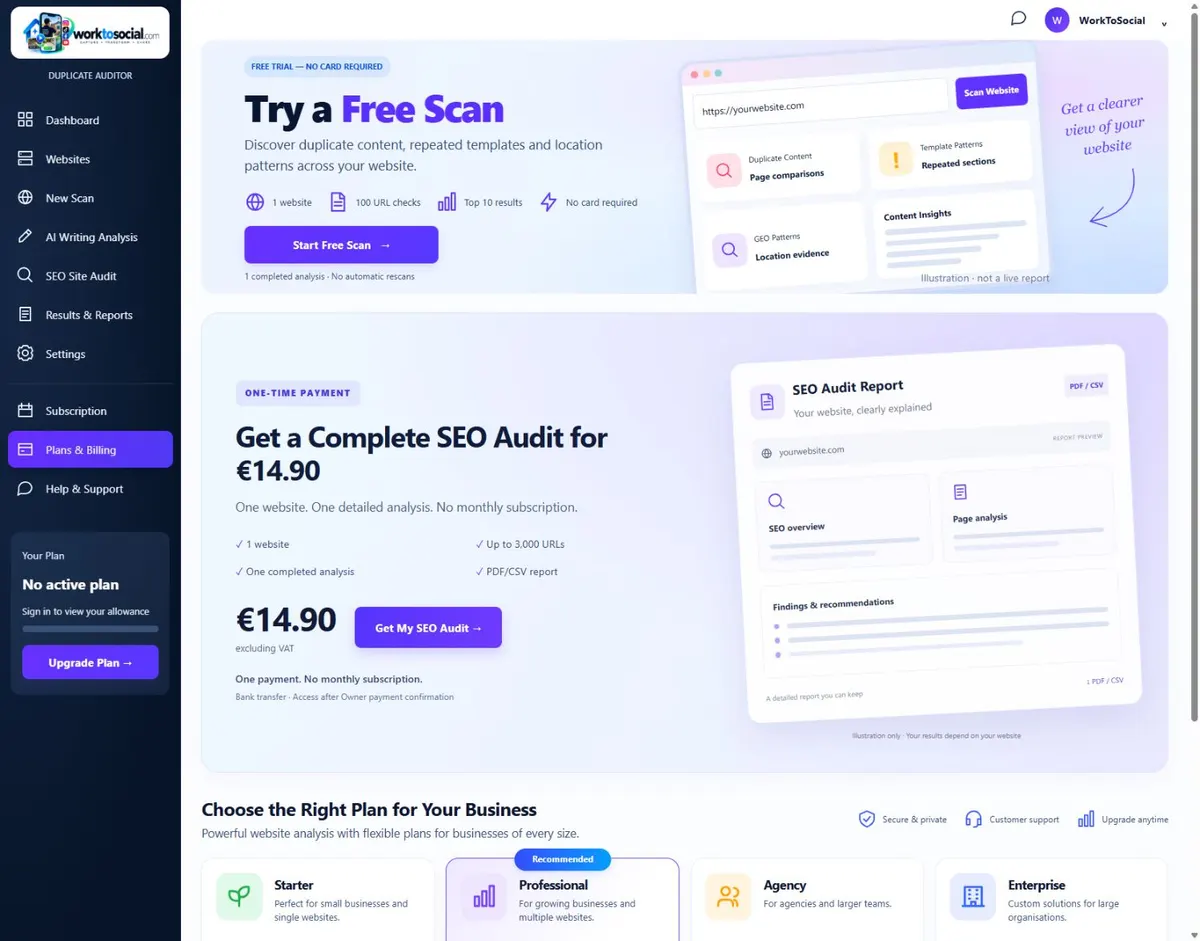
Duplicate content is text that appears in more than one place, either word for word or with only small changes. On a website, it might be a copied service description, a group of location pages with the same paragraphs, or several URLs serving the same article. Near-duplicate pages can look different at first glance while sharing most of their useful information.
Repetition is not automatically a defect. Contact details, delivery terms and navigation often belong on several pages. The useful distinction is between repeated supporting material and repeated main content. A website duplicate content checker helps you find those patterns without relying on a few manual searches.
Similar pages deserve attention when visitors cannot tell which one answers their question, or when maintaining several versions creates inconsistent information. An audit gives you a shortlist for review. It does not establish a search penalty or tell you to delete every matching passage.
Begin with a website you own or have permission to scan. Register, verify your email and choose the available Free Scan or a purchased allowance. Add the website address and confirm your authority to analyse it. The application checks the address and your entitlement before starting work.
The crawler discovers accessible URLs within the product limits and saves the pages it can analyse. Processing then compares the available content and prepares findings. You can follow progress, inspect failures and return to results when the analysis is complete. A large URL allowance is a maximum, not a promise that every URL will be accessible.
Review the evidence before changing your site. Read the compared passages, check the source pages and consider their intended audience. Use reports to organise a content review or share a specific finding with the person responsible for that page.
Content similarity analysis compares the text available from scanned pages. Exact passages and substantial overlap can reveal copied descriptions, repeated service explanations or multiple pages built around the same material. The point is to identify useful comparisons rather than reduce the whole website to a single score.
Open a matching pair and check what is shared and what is distinct. A location page may repeat a service introduction while adding useful local information. Another may change only a place name. Those situations need different decisions. Preserve helpful details and consider consolidation only when the pages genuinely serve the same need.
Headers, footers, menus and standard calls to action can account for a substantial amount of repeated website text. Template similarity helps distinguish the common framework from the page’s main contribution. That context matters when comparing short pages where navigation would otherwise dominate the evidence.
Shared templates are often intentional. Use the comparison to understand where repetition comes from, then inspect whether the body content offers something useful. Automated extraction has limits, especially on unusual layouts. Check the original page whenever a finding appears to confuse navigation or standard wording with the main content.
The SEO site audit organises findings from the available crawl evidence. It supports a technical and editorial review; it does not replace access to your website, analytics or search-performance data.
Review discovered incoming links and pages with few or no observed connections. Potential orphan pages need a wider coverage check: an incomplete crawl cannot establish that a page has no links anywhere on the site.
Inspect available metadata and headings for missing or repeated values. Decide whether each page’s title, description and main heading explain its purpose clearly, rather than applying the same wording to every URL.
Review transport-related evidence recorded during the scan. Check the affected URLs and redirects in context before changing configuration. A failed request may reflect a temporary response rather than a permanent site-wide problem.
Pages sharing prominent topic terms and overlapping content may be candidates for review. These are potential overlaps, not proven competition in search results. Search Console performance evidence is not inferred from matching words.
Inspect repeated passages and low-information sections alongside useful facts and justified boilerplate. The evidence helps you choose an editing task; it is not a universal judgement of a page’s value.
Check discovered, analysed and failed URLs before sharing conclusions. Crawl limits and inaccessible pages affect what the report can demonstrate. Keep that scope attached to any recommendations you make.
AI Writing Analysis looks for writing characteristics that may benefit from editorial attention: generic promotional language, repeated constructions, awkward phrasing, low-information paragraphs, unsupported superlatives and excessive keyword repetition. Findings should be read with their nearby context.
It does not prove that a person or an AI system wrote the text. Useful service details, numbers, locations and sensible instructions are not automatically problems because they recur. A strong page may need no changes. Review the suggested issue and decide whether an edit would make the passage clearer or more helpful. Availability and usage depend on your product entitlement; AI analysis is not an extra promise attached to the free or one-time allowance.
Results connect observations with the scanned URLs and available source evidence. Compare the passages, inspect the relevant metadata and separate a repeated template from a repeated explanation. This makes it easier to discuss a specific change with a writer, developer or client.
PDF and CSV reports are available with the applicable paid product, including the one-time audit. PDF supports a readable handover; CSV supports sorting and follow-up work. Free Scan provides the top 10 results in the application without PDF/CSV export. Keep a copy of purchased reports within the applicable retention period: the current one-time product provides 30-day report availability.
SEO agencies can use the evidence to prepare a client review. Website owners can inspect growing service and location sections. Content teams can find repeated explanations before commissioning another rewrite. WordPress publishers can review accessible published pages without changing their publishing workflow. Businesses with multiple websites can choose a monthly plan that fits their approved allowances.
You remain responsible for permission to scan and for the changes you make. The tool identifies review candidates; people decide what serves their visitors.
Register and verify your email, then run one eligible analysis. See how the evidence is presented before choosing a paid option.
One lifetime trial per eligible customer. Security and shared daily capacity checks apply.
Registration → Email verification → Scan → Results → Upgrade
One website. One detailed analysis. No monthly subscription.
Buy a focused review when you need it. There is no automatic renewal. Your allowance becomes usable after Stripe confirms a successful card payment, with 30-day report availability under the product terms.
Secure card payment through Stripe · Access after payment confirmation
Choose a monthly allowance when you need repeat analysis or manage several sites. All prices exclude applicable VAT; Enterprise requires an individually approved offer.
5 websites · 5,000 URL checks/month
View Starter details →25 websites · 25,000 URL checks/month
View Professional details →150 websites · 100,000 URL checks/month
View Agency details →Individually agreed allowances
View Enterprise details →No. Navigation, legal wording and repeated product details can be useful. The important question is whether pages offer distinct information and serve a clear purpose. Review the matching passages and page context before making changes.
No. Duplicate Auditor compares content within the available website scan and supported comparison scope. It is not a claim of comprehensive internet-wide plagiarism detection or proof of copyright infringement.
No. AI Writing Analysis reviews writing characteristics such as generic wording and repeated constructions. Those observations can also apply to human writing. Use the evidence for editing, not as proof of authorship.
After registration and email verification, an eligible new account can run one completed analysis of one website, with up to 100 URL checks and the top 10 results. It does not include PDF/CSV exports or automatic rescans. Capacity and security checks still apply.
One completed analysis of one website, up to 3,000 URLs, with PDF/CSV reporting and 30-day report availability under the current product terms. This is a one-time payment excluding applicable VAT, without a monthly subscription or automatic renewal.
Checkout provides the applicable total, payment reference and bank instructions. Access is granted only after the Owner confirms receipt. Creating an order or sending a transfer does not activate an analysis immediately.
Coverage depends on accessible links, crawl permissions, URL allowances and technical limits. Login-only content, unavailable pages or links that need JavaScript may be outside the saved crawl. Check the discovered, analysed and failed URL counts before drawing conclusions.
No. Zero discovered inlinks means that no incoming link was found in the available scan graph. Unscanned pages or other discovery sources may still link to the page. Treat these as potential orphan pages until you check wider coverage.
No ranking outcome is guaranteed. Findings help you inspect technical and content issues, but search performance depends on many factors beyond this analysis. Prioritise changes that improve accuracy, usefulness and the visitor experience.
Agencies can analyse websites they are authorised to scan, within their selected plan. Keep permission, customer information and report sharing under your own review. Monthly plans suit ongoing work across multiple sites.
Start with a bounded scan, inspect the evidence and choose the next step that fits your website.