
Ask what the shared text is doing
Open two pages from the same service website and you will probably see the same menu, contact details and booking button. That consistency can help a visitor find their way around. It becomes a different editorial question when the main paragraphs also repeat the same explanation, leaving the visitor unsure why both pages exist.
A similarity finding is a reason to inspect the relationship between pages, rather than an instruction to make every sentence different. Start by asking where the shared words appear and what function they serve. A repeated phone number does a different job from a repeated service description, even if both appear in the extracted text.
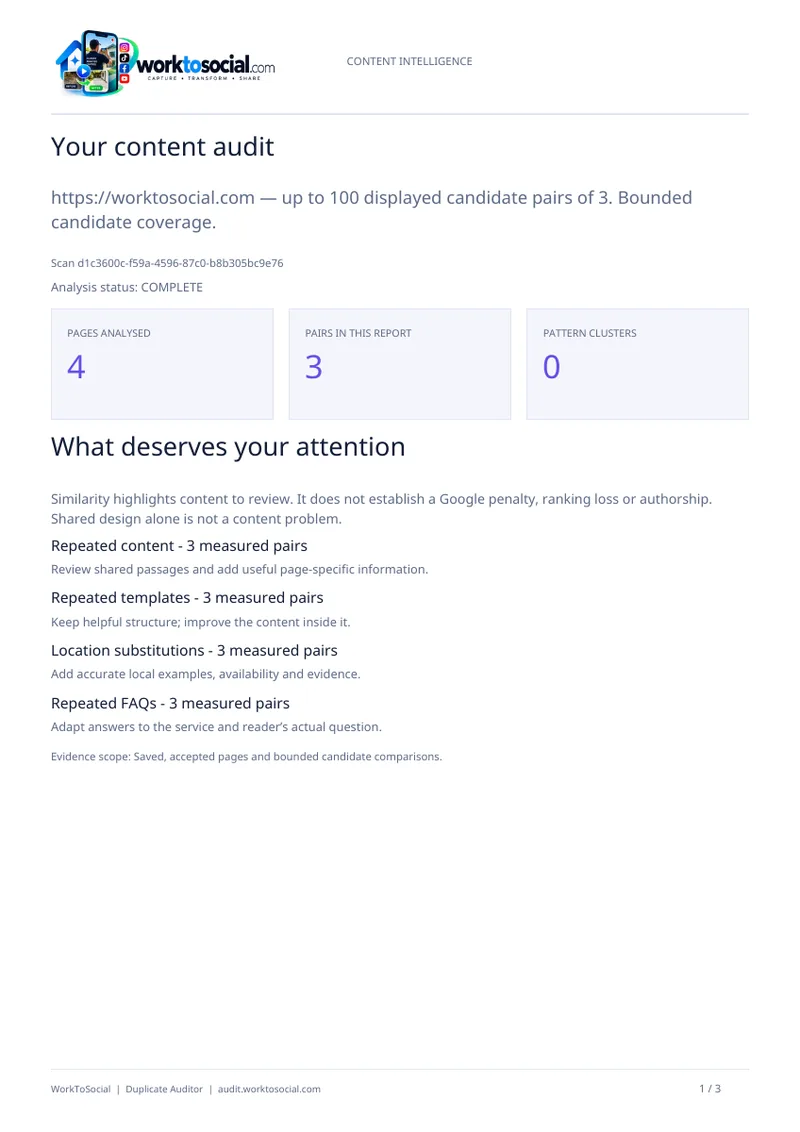
WorkToSocial Duplicate Auditor supports content and template similarity review within the available website scan. Its comparisons help you examine patterns that are easy to miss when opening pages individually. The distinction between framework and message makes that evidence more useful: you can preserve helpful common elements while directing editorial attention towards passages that should explain the purpose of each page.
Separate the website framework from the page explanation
The framework is the material that helps the site function consistently. Navigation, footer links, standard contact routes and recurring calls to action may belong on many pages. Some conditions or company facts may also need to remain consistent. Their repetition is not, by itself, a reason to rewrite or remove them.
The main explanation should help someone understand the particular subject of the page. A service page might explain scope, preparation and how to enquire. A help page might answer a specific question. Shared design does not prevent those pages from making distinct contributions. Equally, changing a heading cannot create a useful distinction when the explanation underneath remains vague.
Treat these as practical categories for review, not a claim that every website has a perfectly clean boundary between them. A standard section can contain facts important to the service, and a custom layout can contain mostly repeated wording. Read the text itself. The editorial decision depends on whether the information is accurate, relevant and useful in that location.
Take extra care when comparing short pages
A short page can contain very little unique explanation alongside a substantial menu and footer. When the whole available text is compared, the shared framework may account for much of what is present. A prominent similarity finding therefore needs context before anyone concludes that the page's useful content was copied.
Consider a hypothetical website with two brief pages: one explains how to request a quotation, while the other provides access instructions for an appointment. Both repeat the same company navigation and contact block. Their distinct instructions could serve different needs even if the overall comparison contains extensive overlap. This is an example to reason through, not a measured customer result.
Now imagine that both pages contain only the same general promotional paragraph, with the heading changed. That deserves a different review. The question becomes whether the visitor receives the instructions promised by each title. Do not lengthen a page merely to dilute the proportion of shared text. Add information only when it helps someone complete the task the page exists to support.

Read one comparison through the original pages
Choose a relevant matching pair and open both live source pages. Note each URL, title and intended purpose. Then locate the passages highlighted by the comparison. Are they navigation labels, standard business facts or the central explanation? Does the live page provide context that was unclear in the extracted version?
Read the distinct parts as carefully as the matching ones. A common introduction may be followed by useful preparation details on one page and accurate exclusions on another. That could justify keeping both pages while improving the introduction. Alternatively, the supposed differences may amount to a place name or a few adjectives that never explain a separate need.
Use our guide to reviewing duplicate content for the broader decision process. For this first pass, aim for a precise observation: shared booking wording is intentional, but the second page lacks the information its heading promises. That is a stronger brief than a general request to lower similarity across the site.
Work through a hypothetical service-page pair
Imagine a home-maintenance business with pages for recurring maintenance visits and one-off repair enquiries. This is a hypothetical example, not a customer case study. The pages use a common layout and repeat the company contact details, operating-area statement and enquiry button. Those elements may be entirely appropriate on both.
The body text needs a closer look. If both pages say only that the team offers reliable help, a visitor cannot understand the difference between arranging an ongoing visit and describing a particular repair. The office should confirm the actual process for each. What information is needed, what happens after an enquiry and which details affect the initial assessment?
After those facts are verified, the writer can explain each process clearly. Shared company information can remain consistent. The result is not a completely different vocabulary but a more useful explanation of the customer's next step. Our service-page content review shows how to turn those operational questions into an editing task without inventing prices, availability or guarantees.
Recognise extraction and coverage limits
Automated extraction has to interpret the retrieved page structure. An unusual layout can make navigation look like body content or make an important section difficult to identify. Content loaded through browser-side JavaScript or available only after a login may be outside the saved scan. A comparison should be read as evidence from what was available, rather than a complete account of every visitor experience.
If a finding seems inconsistent with the original page, document the discrepancy. Check whether the expected content appears in the scanned evidence and whether retrieval succeeded. Do not redesign a functioning menu merely to compensate for an extraction ambiguity. A developer may need to investigate how the page exposes its meaningful content before the editorial team acts.
Review discovered, analysed and failed URLs as well. An unanalysed page cannot contribute its missing explanation to the comparison. A pair drawn from a bounded scan does not establish an internet-wide duplication problem. Keep the coverage and capture context attached to any recommendation, particularly when sharing a report with someone who has not seen the original pages.
Choose an action that matches the actual issue
There are several reasonable outcomes from a comparison. Keep accurate shared navigation and business facts. Improve a page that needs clearer service-specific information. Ask a developer to inspect an extraction problem. Review whether two URLs serve the same need when you cannot identify a distinct purpose. The finding helps frame these choices; it does not select one automatically.
Write an editing brief with the affected URLs, the passage under review, the customer question and the colleague who can confirm the answer. Avoid instructions such as make it unique, which invite decorative rewrites without improving the information. If the problem is a shared inaccurate condition, consistency may require correcting several pages together.
Removal, consolidation and redirects are broader website decisions that need appropriate review. A matching passage alone does not establish a search penalty or prove that pages compete in search results. Assess those questions with the relevant additional evidence. Start with an improvement you can justify from the page's actual purpose and verify the published explanation afterwards.
Use Duplicate Auditor for a focused first review
Begin with a website you own or have permission to scan. Follow registration, email verification and the applicable allowance checks on the Duplicate Auditor product page. When results are available, inspect the scan coverage and choose one comparison connected to a real content question.
Open the source pages, separate the common framework from the main explanation and record the proposed action. Where your paid entitlement includes reporting, PDF or CSV evidence can support a handover; the Free Scan does not include those exports. Keep the relevant scope with the report so the recipient understands what was and was not analysed.
After an edit, read the revised page alongside its neighbour and test the practical next step. A later authorised analysis may help inspect the changed evidence within the available allowance, but it cannot guarantee rankings or enquiries. The useful standard is simpler: visitors should understand the difference between pages, find accurate shared facts and know what to do next without having to decode repeated promotional wording.
Competitor Spy and Duplicate Auditor have their own plans and usage limits. Media & Social is coming soon. Product findings support human review; they do not guarantee rankings or commercial results. Check the linked product pages for current details.