Ask what the audit actually examined
An audit can contain useful findings while still offering an incomplete picture of a website. Some pages may be accessible, others may fail and another section may never be discovered. Reading a result without that context can turn a narrow observation into a much larger claim about the whole business website.
Start with the question the review needs to answer. If you are examining repeated service descriptions, identify which service pages were available for comparison. If you are reviewing internal connections, ask whether the pages that might supply those links were included. The same scan can provide strong evidence for one task and limited evidence for another.
WorkToSocial Duplicate Auditor prepares findings from the available website scan. It supports a bounded review rather than a promise that every page has been examined. Keep that scope visible when deciding what to change, commissioning work or explaining an observation to a client. Confidence should come from inspected evidence, not from how decisive a summary sounds.
Keep discovered, analysed and failed URLs distinct
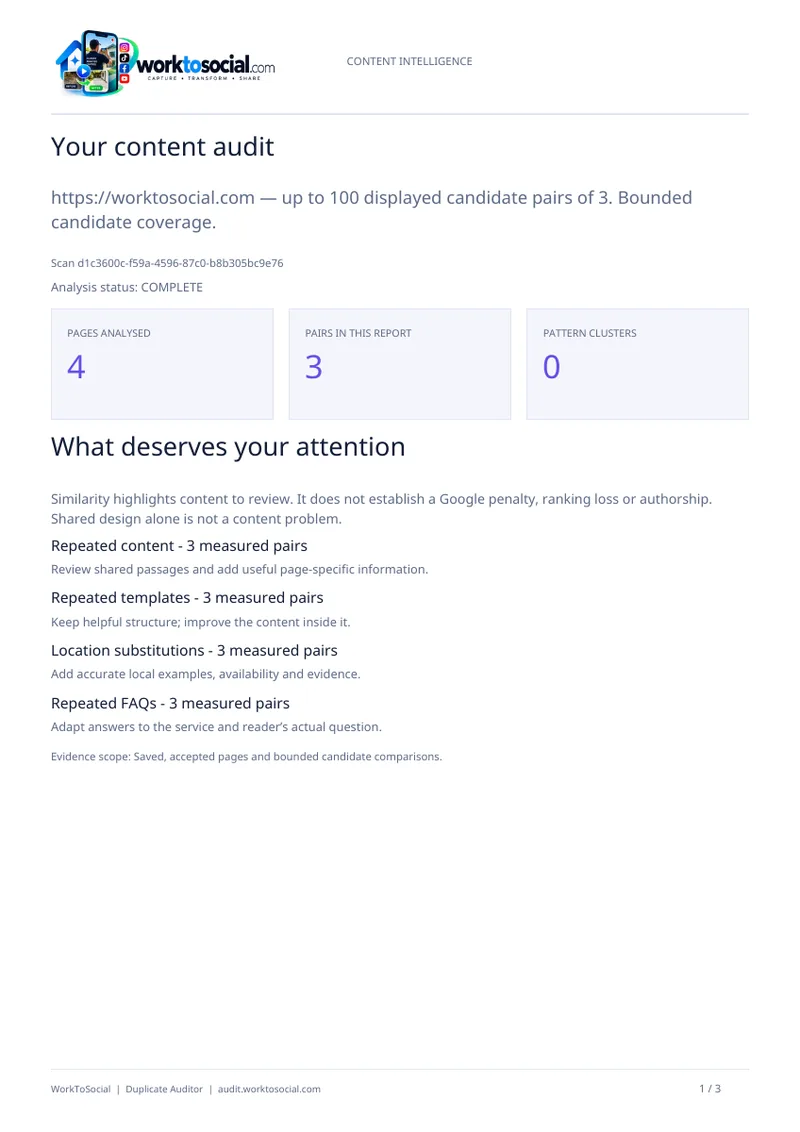
A discovered address is a candidate the crawl found. That does not by itself establish that its content was retrieved and analysed successfully. The analysed set is the material available to the relevant processing. Failed or unavailable URLs identify gaps that need attention before you generalise from the results.
Read the recorded states alongside the counts. A scan may stop because of its allowance, access conditions or technical limits. Do not assume that every missing page represents a website defect or that a smaller analysed set means the website has little content. The relationship between discovered and analysed addresses deserves an explanation, not a guess.
Write a short coverage note before the editing recommendations. State the website, the scan context, the available counts and any important exclusions. If the figures or states are unclear, resolve that question first. An honest note such as the services section was partly available is more useful than describing a partial crawl as a complete website review.
Treat an allowance as a limit, not a completeness guarantee
Product allowances define the scope available to a customer. They do not make every URL reachable or ensure that the crawler will discover an address that is not exposed through accessible routes. A generous maximum cannot compensate for a blocked section or a link that is absent from the retrieved evidence.
The Duplicate Auditor overview explains that permission, accessible links, crawl allowances and technical limits all affect coverage. Review your current entitlement and the completed scan before choosing the next step. A Free Scan is a bounded introduction, with one eligible completed analysis and no automatic rescans or PDF/CSV exports.
Avoid planning work on the assumption that a limit is the number of successful pages you will necessarily receive. Instead, check which important page groups were represented. A smaller but relevant set can support a focused task, while a larger set missing the section you care about may still leave your central question unanswered.
Investigate access and retrieval gaps without bypassing controls
A page that opens for a logged-in colleague may not be available to a public website crawler. Some content may also depend on browser-side JavaScript or on interaction that is not represented in the saved crawl. Distinguish what a visitor can see in a particular session from what the analysis actually received.
Inspect failed URLs and their context before asking for a change. A temporary response, a redirect or an unavailable resource needs a different investigation from a page outside the authorised scope. Ask the person responsible for the website to assess whether the observed behaviour is expected. Do not remove security protections merely to produce a fuller-looking report.
Keep any access limitation attached to the finding. A missing comparison does not prove the page is unique, and a failed retrieval does not prove the business removed a service. If another authorised analysis is appropriate, use the applicable allowance and check its actual result. Do not promise that repeating the request will resolve every gap.
Read internal-link observations within the available graph
An internal-link review depends on the pages and links the crawl observed. If a page has no discovered incoming links, that is an observation about the available graph. It is not proof that no page anywhere on the website links to it. An unanalysed section may contain the connection you need to inspect.
Treat a potential orphan-page finding as a question for wider review. Check the source page, relevant navigation and other known routes within the authorised website. Ask whether the page has an intended role and how a visitor should reach it. Keep a distinction between improving navigation and deleting a page because its recorded connection count is low.
The same care applies to repeated metadata and content comparisons. If an important group is absent, the report cannot establish what happens within that missing group. Our template and main-content guide explains another layer of context: the available text still needs a human reading before an editing decision is justified.
Work through a hypothetical partial crawl
Imagine a small service website with twelve known service and location pages. This is a hypothetical example, not a customer result. A reviewer has a scan containing ten discovered addresses, eight analysed pages and two failed URLs. The reviewer also knows of two relevant pages that are absent from the discovered set.
One analysed pair repeats a service introduction. That pair can support a useful comparison: inspect both sources and decide whether each explains a distinct customer need. It cannot establish that the two undiscovered pages have no repetition. The reviewer records those missing pages as a coverage question rather than silently treating them as checked.
A different page shows no incoming links in the available scan. Before calling it definitively orphaned, the reviewer examines the relevant navigation and the missing service section. A colleague identifies an existing route that was outside the captured material. The recommendation changes from a broad structural claim to a narrower request to review how clearly visitors can find the page.
The practical output is a coverage note, one content comparison and a small list of retrieval questions. The team has useful work to do without pretending the audit answered every question about the website.

Make the handover precise enough to review
Keep the coverage note with the findings when you share them. Where the purchased product includes reporting, PDF or CSV files can support a handover, but the recipient still needs to understand the scan scope. A detached spreadsheet row can lose the distinction between an observed issue and a review candidate.
For each proposed action, name the affected URLs, describe the source evidence and identify the uncertainty that remains. Assign the person who can check it. A developer may investigate retrieval behaviour, while a writer and service owner review the accuracy of a repeated passage. These are separate tasks even when they arise from the same scan.
Avoid turning the handover into a ranking forecast. Similar wording, missing metadata or a limited link graph does not prove a search penalty or a commercial effect. Prioritise changes you can justify in terms of accurate information, usable navigation and clear page purpose. Additional performance questions require their own evidence.
Check coverage again when assessing a change
After editing, open the published sources and verify the intended changes. If an authorised later analysis is used, compare its scope with the earlier one before interpreting differences. New pages, different retrieval outcomes or changed limits can alter the available evidence as well as the content findings.
A finding disappearing is not automatically proof that the underlying issue was resolved. The affected page might be outside the newer analysed set. Conversely, a new comparison may appear because coverage expanded. Keep the URLs and capture context alongside the review so the team can separate a content change from a change in what was examined.
To begin, explore Duplicate Auditor and choose a website you own or are authorised to scan. Read the coverage before the conclusions, inspect one relevant finding and give the next step an owner. A bounded recommendation with clear evidence is something your team can act on and revisit.
Competitor Spy and Duplicate Auditor have their own plans and usage limits. Media & Social is coming soon. Product findings support human review; they do not guarantee rankings or commercial results. Check the linked product pages for current details.